
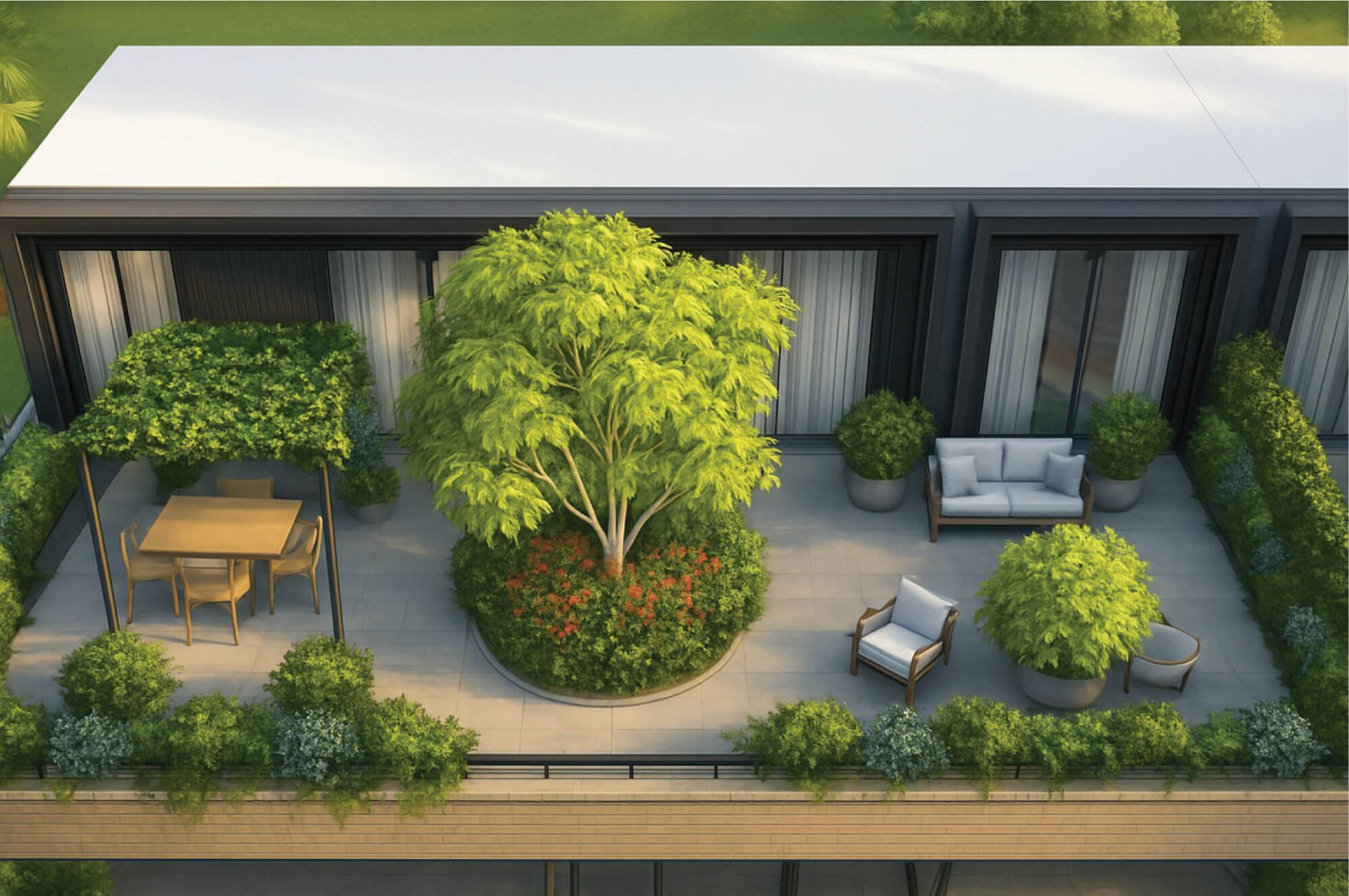
Character Of The Issue – Requirements
When opting for green roofs, where the waterproofing layer is situated beneath the planting-drainage system, it is crucial to ensure that the sealant effectively resists residual moisture trapped between the system and the waterproofing layer. Additionally, the sealant must exhibit excellent adhesion to the substrate, as well as attributes of flexibility, reliability, and durability.
SOLUTION
The PC-WC Bituminous Membrane System, particularly the APP-based torch-applied membrane, thoroughly meets these requirements. This cutting-edge technology stands as one of the most resilient waterproofing solutions in the history of the field.
Application
Preparation of the substrate
The substrate must be dry, with a moisture content of less than 4%, and free from loose particles, dust, grease, and other contaminants. Local restorations or repairs of roof elements, such as concrete and cement mortar, should be executed using polymer-modified, fiber-reinforced PCC R3 cement mortar, specifically PC-Conrend® HS RM.
If any concrete cracks are present, they should be cut into a V-shape, and PC-Crack Seal® paste should be applied. For structural cracks that could compromise the integrity of the overall structure, the PC-WC injection repair system should be utilized.
Installation of transitional fillets and coves
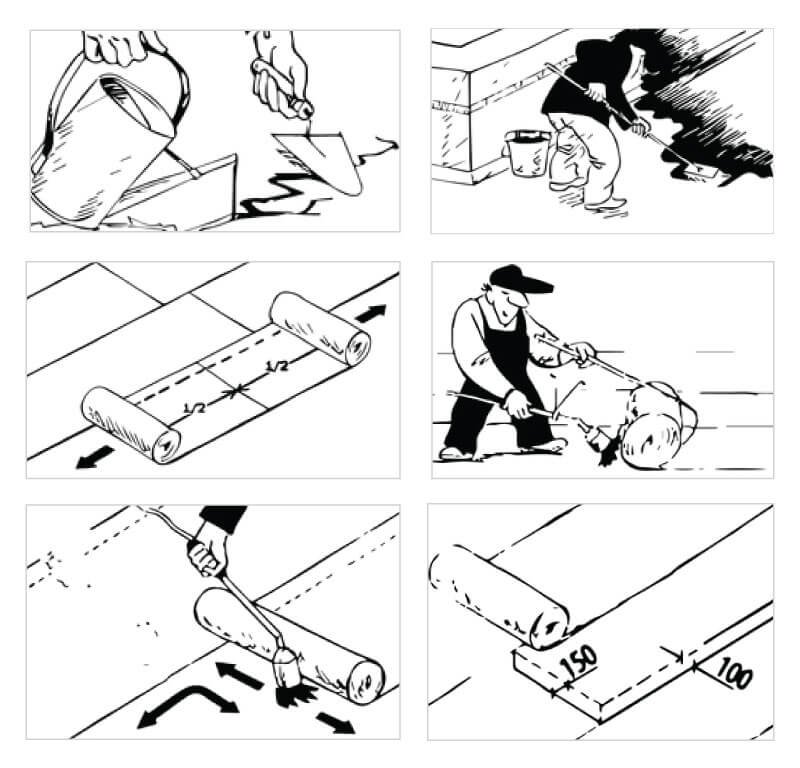
Before applying the polymer-bitumen roll materials, it is necessary to eliminate all sharp protuberances, corners, etc. to avoid the material crushing or static punching of the waterproofing membrane (e.g., when filling of a foundation pit with backfilled soil and in process of operation of a building), for which it is necessary to arrange transitional fillets or coves. Fillets are usually made of cement-sand grout of at least M150 grade or polymer-cement slurry with fast strength setting. In any case, the size of fillets should be around 100 × 100 mm.
Priming the surface
When applying polymer-bitumen roll-fed materials utilizing the torching method, it is crucial to ensure proper adhesion to the substrate, ideally between 0.3 and 0.5 MPa. To enhance this adhesion, the concrete surface should be primed with a ready-to-use BITUMEN PRIME COATING. The approximate consumption of the primer is between 0.25 and 0.35 liters per square meter, contingent upon the texture and absorbency of the substrate.
Torch-on application of the waterproofing membrane
- The surface must be thoroughly cleaned of dust, debris, grease, and leaves, ensuring it is free from gaps, cracks, or other irregularities. Prior to the installation of the waterproofing material, the surface should be treated with a primer.
- During installation, both the material and the substrate must be uniformly heated with a torch across the entire width of the roll. Additionally, areas of overlap should receive extra heating. Proper installation requires that the entire surface of the material adheres to the base, with bitumen oozing from the edges by approximately 5–10 mm.
- The membrane should be positioned at least 300 mm away from the overlaps of the underlay membrane; however, it is typically placed 500 mm away (50% of the roll width). Furthermore, the distance between different end laps of rolls must be a minimum of 500 mm.
- The overlap at the edges should be 100 mm, with a recommended overlap of 120 mm for single-layer applications of bitumen membrane. The overlap at the ends of the sheets should not be less than 150 mm. The minimum length of rolled material that can be installed is 1 m.
- The roofer should remove coarse-grained slate from the locations of the end laps of the cap sheet membrane, as this significantly hinders material adhesion. The upper side of the material (with slate) must be additionally heated with a torch at these overlay locations. Subsequently, the slate should be pressed into the bitumen using a spatula.
Installation of the Geotextile
Following the installation of the bituminous membrane, a polypropylene nonwoven geotextile, weighing 130 g/m², is laid out, ensuring the sheets overlap by 10 cm. This layer serves to protect the substrate from damage while also enhancing ventilation within the system.
Application of PC-Plantoper® geo type drainage membrane
The multilayer drainage membrane, PC-Plantoper® geo, is constructed from high-density polyethylene (HDPE) and has a thickness of 0.6 mm. This membrane features octagonal dimples that rise 20 mm in height, accompanied by an adhered geotextile filter made of polypropylene, weighing 100 g/m².
Additional technical specifications include:
Compressive strength: 200 kN/m²
Air gap: 14 l/m²
Water storage capacity: 7 l/m²
Temperature resistance: -30ºC to +80ºC
The sheets of the drainage membrane can be interconnected using the specialized connectors and rivets provided in the package. To safeguard the green roof system from contamination during soil filling, strips of high-density polyethylene are mechanically fastened to the upper edge of the drainage membrane. Soil and planting can be introduced immediately following the installation of the PC-Plantoper® geo drainage membrane.
DOWNLOADS
Waterproofing Solutions
Garden & Planted Areas
