
Character Of The Issue – Requirements
Waterproofing flat roofs, whether applied during construction or as a post-construction measure, must not only guarantee complete watertightness but also exhibit exceptional resistance to weathering, reliability, durability, elasticity, and strong adhesion to the substrate.
If the flat roof is intended for frequent pedestrian use, it is essential that the exposed surface provides adequate slip resistance and maintains color stability over time, particularly in darker shades. Additionally, the surface must withstand mechanical stress and friction while demonstrating long-term resistance to ultraviolet radiation.
SOLUTION
The requirements are comprehensively met by the polyurethane liquid membrane system, PC-Sealcoat® 220 and PC-Sealcoat® TOP. PC-Sealcoat® 220 serves as a one-component, polyurethane waterproofing liquid membrane specifically designed for flat roofs, functioning as the foundational layer of the system. In contrast, PC-Sealcoat® TOP is a one-component, aliphatic, elastic polyurethane paint that forms the final exposed surface.
This dual-material system exhibits exceptional adhesion to various substrates, high flexibility, and significant resistance to weathering and ultraviolet radiation. It also demonstrates considerable resistance to standing water, making it suitable for roofs with less-than-ideal slopes.
The system creates a continuous, elastic membrane characterized by outstanding mechanical strength, free of joints or seams, and is suitable for universal sealing of roof surfaces. Additionally, it can serve as a sealing layer for balconies, patios, sidewalks, and areas with light vehicle traffic, such as parking lots.
Surface Preparation
Preparation of the substrate
The substrate must be dry, with a moisture content of less than 4%, and free from loose particles, dust, grease, and other contaminants. Local restorations or repairs of roof elements, such as concrete and cement mortar, should be executed using polymer-modified, fiber-reinforced PCC R3 cement mortar, specifically PC-Conrend® HS RM.
If any concrete cracks are present, they should be cut into a V-shape, and PC-Crack Seal® Paste should be applied. For structural cracks that could compromise the integrity of the overall structure, the PC-WC injection repair system should be utilized.
Surface priming
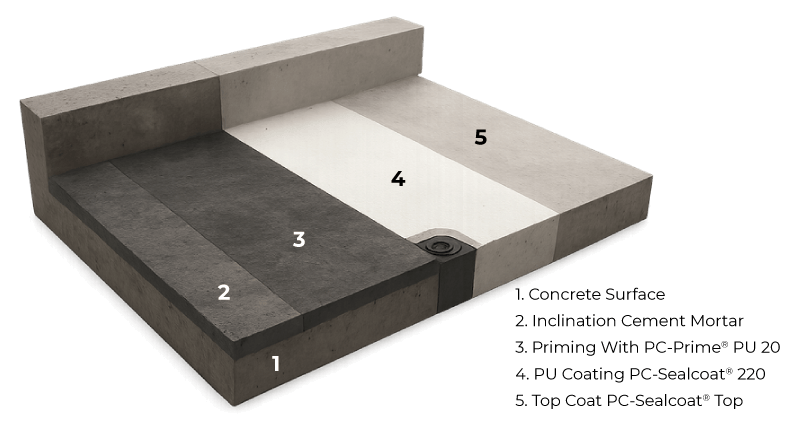
Once the smoothing materials are dry, apply the one-component polyurethane primer, PC-Prime® PU 20, to a clean, dry concrete surface with moisture below 4%. Use a brush, roller, or spray for uniform application, with a recommended consumption of 200–300 g/m².
Application of PC-Sealcoat® 220
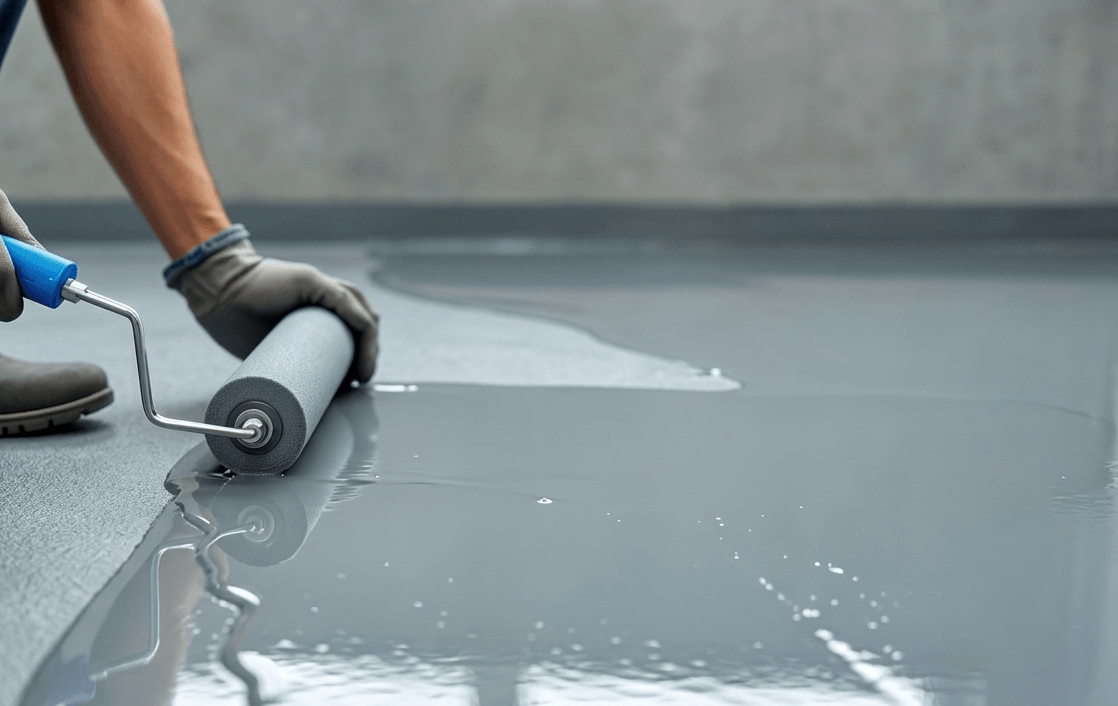
Upon the drying of the polyurethane primer PC-Prime®PU 20, which takes approximately 2 to 3 hours, the polyurethane waterproofing liquid membrane PC-Sealcoat® 220 is reinforced with 100 cm wide strips of polyester fleece (60 g/m²), referred to as PC-Seal Tape® Flex. These strips should overlap by 10 cm. The first application of the PC-Sealcoat® 220 membrane is intended to cover the reinforcement layer (extending to a width of 100 cm), and while it remains fresh, the polyester fleece strip is embedded. This application procedure is replicated across the remaining surface. Once this layer has cured, typically within 8 to 24 hours depending on environmental conditions, two additional layers of PC-Sealcoat® 220 are applied over the entire roof surface, ensuring complete coverage of the reinforcement. The second coat can be applied as soon as the first has dried, within the same 8 to 24-hour timeframe dictated by weather conditions.
The total consumption of the polyurethane waterproofing liquid membrane PC-Sealcoat® 220 is estimated at 2.0 to 2.25 kg/m², contingent upon the substrate. Waterproofing must extend to vertical surfaces such as parapets and stairwell terminations to a minimum height of 15 to 20 cm, creating a watertight basin.
For any substrate cracks wider than 1 mm, local priming and sealing with the epoxy-based crack sealing compound PC-Crack Seal® Paste is required. Cracks measuring less than 1 mm do not necessitate sealing.
(A) Creating a Smooth Surface
To form a smooth finish, apply the one-component, aliphatic, elastic polyurethane top coat PC-Sealcoat® Top. Once the final layer of PC-Sealcoat® 220 has dried, the entire surface can be brushed with the aliphatic polyurethane top coat. This top coat should be applied by roller in two layers, with the second layer applied crosswise to the first after 4 to 24 hours, depending on weather conditions. The consumption for the aliphatic polyurethane top coat PC-Sealcoat® Top is approximately 0.30 to 0.35 kg/m², based on the substrate.
(B) Creating a Slip-Resistant Surface
To achieve the necessary slip resistance on the final surface, adhere to the following procedure: In the last total layer of the brushable waterproofing membrane PC-Sealcoat® 220, while it is still fresh, broadcast dry quartz sand (Ø 0.3-0.8 mm). After the membrane has cured, any loose grains should be removed using a high-suction vacuum cleaner. The estimated consumption of quartz sand is approximately 2.5 to 3.0 kg/m².
Following this, once the last layer of PC-Sealcoat® 220 has dried and any loose quartz sand has been cleared, coat the entire surface with the one-component, aliphatic, elastic polyurethane top coat PC-Sealcoat® Top. This top coat should also be applied by roller in two layers, with the second layer applied crosswise to the first after 4 to 24 hours, subject to weather conditions. The consumption for the aliphatic elastic polyurethane top coat PC-Sealcoat® Top is approximately 0.40 to 0.45 kg/m², depending on the substrate.
Remarks
PC-Sealcoat® 220 can be applied when the ambient temperature is at least 5ºC and rising, provided that the substrate temperature is a minimum of 3 degrees above the dew point. The maximum application temperature is approximately 35ºC. It is important to note that low temperatures may retard the curing process, while high temperatures can accelerate it. Additionally, high humidity levels may adversely affect the final finish of the membrane.
The maximum consumption of PC-Sealcoat® 220 per layer should not exceed 750 g/m². Care should be taken to avoid excessive stirring of the polyurethane waterproofing liquid membrane meant for flat roofs, as well as the aliphatic polyurethane top coat, to prevent air entrapment.
For safe use and precautions, please refer to the instructions provided on the packaging.
DOWNLOADS
Waterproofing Solutions
Accessible Flat Roof
